The problem
Three things kept coming up in my AP Macroeconomics class.
- Graph shifts cost points. Students mix up which curve moves, which way it moves, and the sentence that explains why. That sentence is what earns the point on the exam.
- Review days felt flat. A worksheet of practice graphs does not hold a room of seniors.
- Practice stopped at the bell. Students needed a way to keep practicing at home, on their own phones.
Who it is for
My AP Macro seniors, on their own phones and on shared Chromebooks, and the whole class together on the projector.
What I built
Seven short games, each aimed at a skill the exam grades. I made them with AI tools and checked every question and every explanation myself.
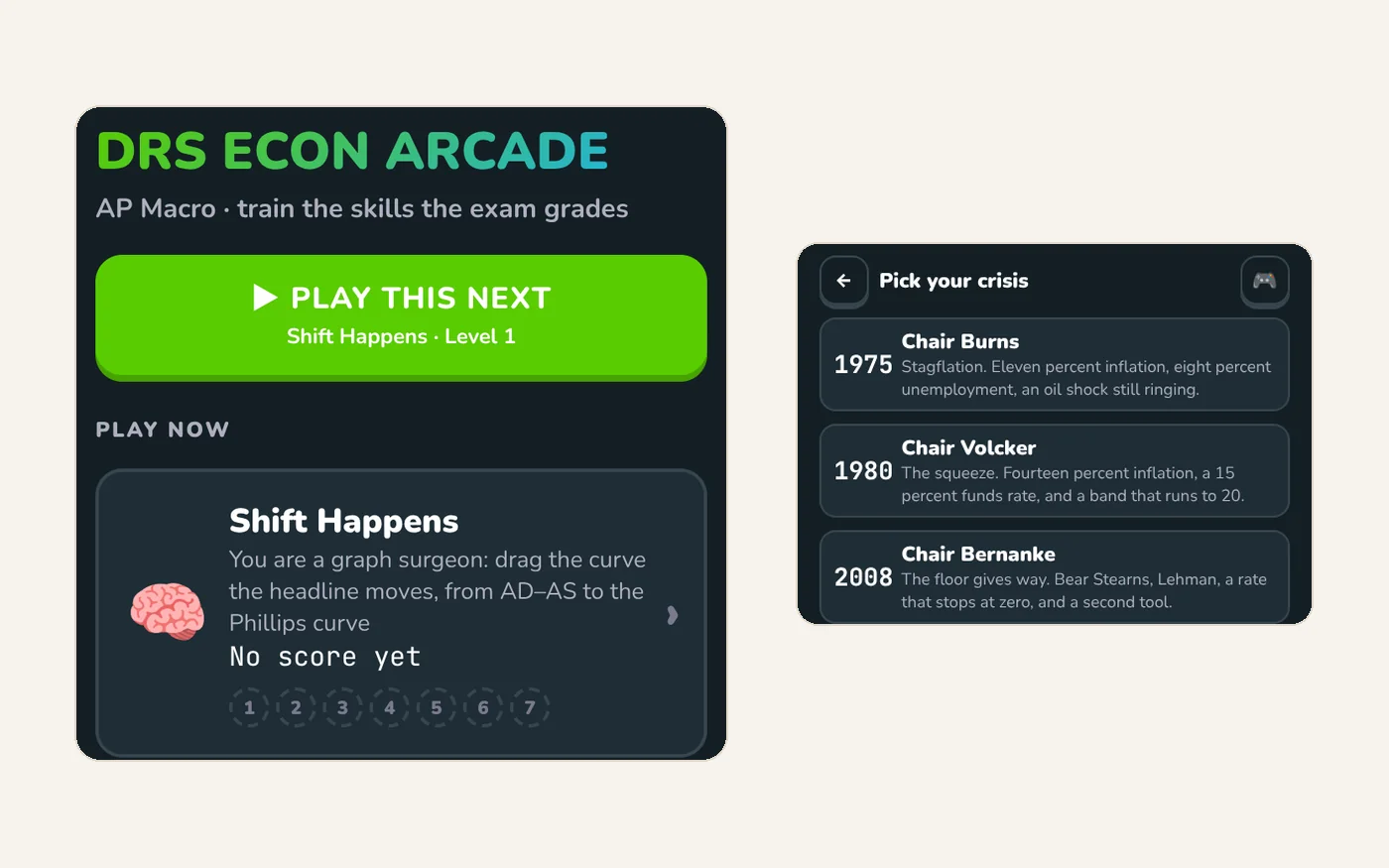
The game list, and Fed Chair asking which crisis to run.
| Game | What students do |
|---|---|
| Shift Happens | Read a headline and drag the curve it moves, from AD-AS to the Phillips curve. |
| Fed Chair | Run the Fed in 1975, 1980, 2008, or 2021: set the rate, then live with the lag. |
| Graph Doctor | Find the planted mistakes on a drawn graph before the clock runs out. |
| Sort Circuit | Sort cards into the right bins, from what counts in GDP to the balance of payments. |
| Calc Blitz | Dial in the number the exam wants, from the CPI to the money multiplier. |
| The Investor | Start with $10,000 for twelve quarters: read the Fed, split the money, and keep its real value. |
| Crisis Country | Play policy cards as finance minister to steady a country in trouble before the election. |
Design choices
The why after every answer
Right or wrong, students see one sentence written the way it would earn the point on the free-response section. They practice the exam's language, not just the answer.
Headlines from home
Many cards are set in places my students know, like Woodmere, Lawrence, and Central Avenue, so the economics happens somewhere real.
A map of what to study
A readiness panel shows each student a heat map of the six units, their weakest topic, and the level to play next. A readiness code goes into Schoology.
Built for the room too
Arcade Night puts the game on the projector in big type for whole-class review. A read-aloud voice and a glossary of exam terms help every student keep up.
How students use it
- Before unit tests, as review.
- In class, on the projector in Arcade Night mode.
- At home, on their own, as extra practice.
What I have seen, and what I changed
Students ask for more games and more levels. I made it work better on phones.
Student privacy
No accounts. Scores stay on each student's device. The class leaderboard stays off unless a teacher sets it up. Then it sends three initials, the game, the level, the score, and the student's arcade title and points to a Google Sheet the teacher owns. No names and no emails. Otherwise the pages load only their own files and Google Fonts.
What I would do next
Write a teacher guide for each game, so another AP teacher can pick one up and run it in a single class. The first one is for Shift Happens.